The AI IKEA Fallacy
Why We Overestimate our Role when Working with AI

Think about the last time you were on a trip and saw an amazing view. Your first instinct was probably: I need to take a picture of this.
You pull out your phone, point, tap once, and instantly get a beautiful photo. It is sharp, well lit, and somehow captures the moment better than you expected. You might even think to yourself, or hear a friend say, “you are a great photographer!”
But in that brief moment between the tap and the result, your phone is doing much more than it seems. It stabilizes the image, adjusts the light, sharpens details, balances colors, and improves the final result. What feels like a simple action is actually a complex process happening behind the scenes.
Professional photographers know this well. Capturing a great picture is not just about pointing and shooting. It involves adjusting settings like ISO, exposure, shutter speed, and focus, usually with intention and experience. On smartphones, machine learning does a lot of that work for us.
Still, most of us do not confuse taking a nice phone picture with being a professional photographer.
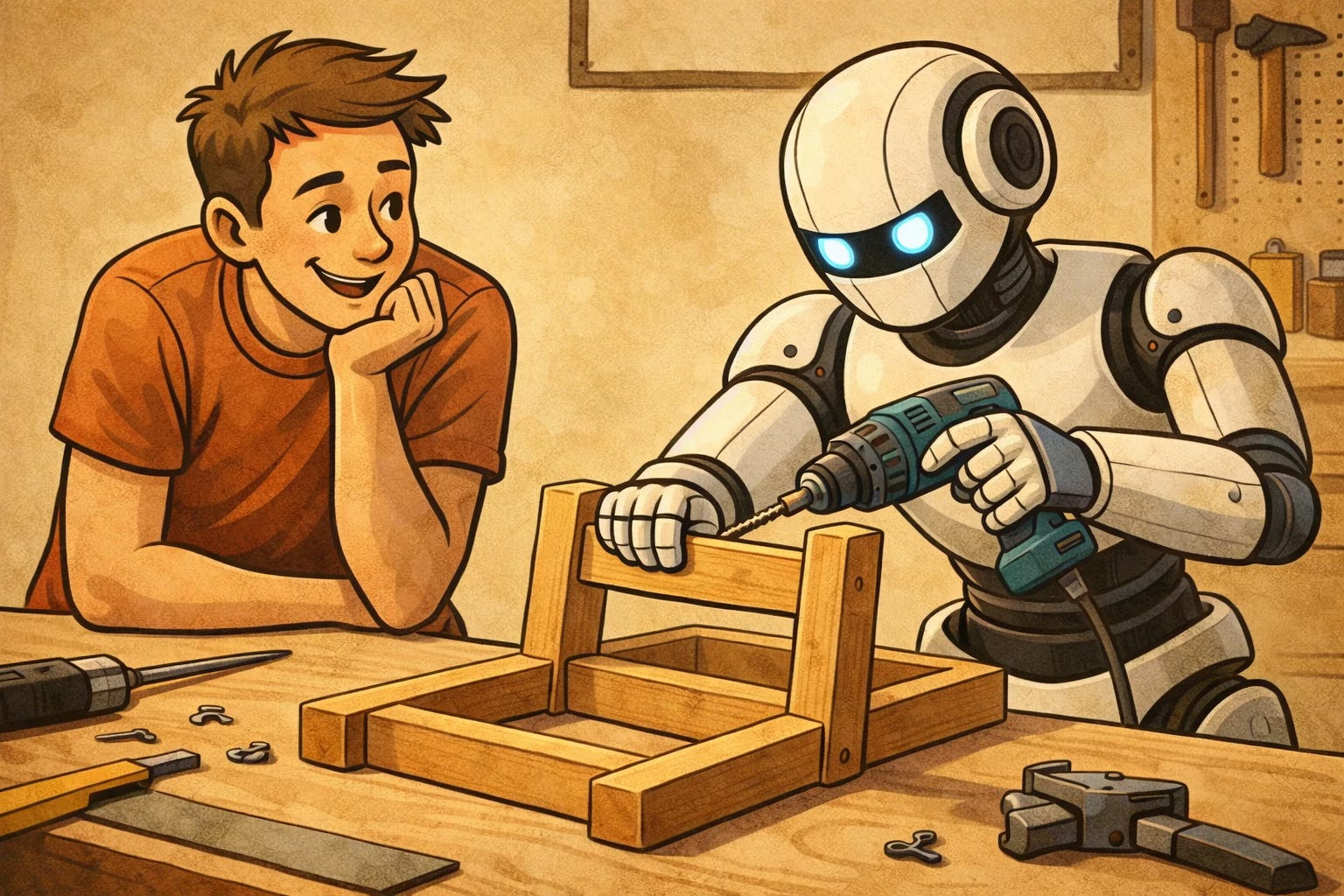
The same thing happens with furniture. You walk into someone’s apartment and see a beautiful shelf or a clean, modern desk. You compliment it. You might assume the person has good taste in design. But you probably do not stop to ask whether they built it, assembled it from a kit, or just ordered it online. Nobody confuses assembling an IKEA shelf with carpentry.
In both cases, there is a natural boundary between the tool and the craft.
With AI, that boundary disappears.
In the AI courses I teach for business, and in my conversations with executives, I keep seeing the same pattern: a lot of excitement. People are vibe coding, drafting reports, generating ideas, building prototypes. Tasks that used to require years of training now feel accessible in minutes. And at the same time, more and more self-proclaimed AI experts are selling courses, tutorials, and easy promises. The message is basically: AI can turn almost anyone into a founder, coder, strategist, or expert overnight.
I do not buy that. And the reason comes down to a misunderstanding about what these tools actually do.
The difference is that AI operates in the same space as the expertise itself. When AI writes code, it produces code. When it writes a strategy memo, it produces a strategy memo. And because the work is creative, because it involves writing, thinking, designing, and building, the boundaries between your contribution and the machine’s become much harder to see.
This is where people fall into what I call the IKEA fallacy.
I use “fallacy,” not “effect,” on purpose. The original IKEA effect, studied in behavioral economics, is about people valuing something more because they helped build it1. The AI version is a bit different. With AI, the problem is not only that we value the output more. The problem is that we start to overstate our own role in making it.
Because we write the prompt, give instructions, and ask for revisions, it feels like we created the result. And yes, we did participate. But often not as much as we think.
I notice this most when I think about something as simple as building a website. In the early 2000s, even a basic HTML page took time and patience. I still remember programming classes where making a simple page with colored text on a white background already felt annoying. It was technical, slow, and not very intuitive. Later, tools like Squarespace made this easier, but you still had to think through layout, structure, navigation, and design.
Now the experience is completely different. You can open a tool like Manus, Claude Code, or Codex, describe what you want, and minutes later get something that looks amazing. You start to feel that you built the whole thing, when in many cases you mostly started with a prompt. Direction has value. But direction is not the same as full authorship, and it is definitely not the same as mastery.
And this problem gets worse because of something else: people tend to take AI output at face value. The result looks polished, so they assume it is good enough. They stop checking. They stop questioning. And that is where the AI IKEA fallacy feeds into something even more dangerous.
There is a well-known psychological mechanism behind it: the halo effect2. The halo effect is the tendency to let one positive quality color your judgment of everything else. If someone is attractive, we tend to assume they are also smart and trustworthy. If a presentation looks professional, we tend to assume the reasoning behind it is solid too. One good signal spills over into areas it has nothing to do with.
AI triggers this constantly. It gives you something clear, organized, and confident. It looks finished. And because it looks finished, the halo effect kicks in: people stop questioning the substance. They start to assume that good structure means good reasoning, that smooth language means sound judgment, and that a professional tone means the content is reliable.
But polish can hide serious problems. We have already seen lawyers submit AI-generated briefs with citations that looked real but were fake3. We have also seen students and researchers rely on AI-generated literature reviews filled with convincing references that did not exist4. The writing looked professional. The substance was broken.
Together, these two problems create a dangerous feedback loop. The AI IKEA fallacy makes you feel like you built the thing. The halo effect makes the output look like it does not need further scrutiny. You feel ownership over something you did not fully create.
Let me be clear: none of this means AI is a bad tool. Quite the opposite. AI can make us faster and, in many cases, better. The problem is not the tool. The problem is passive use.
When people rely too much on AI and stop actively evaluating what it produces, they become less likely to catch errors, challenge assumptions, or notice what is missing. They fall asleep at the wheel.
So what should we do?
First, we should understand, at least at a basic level, how these systems produce their output. I am not saying everyone needs to become a machine learning engineer. But people should know the basics: what these models are trained to do, what they optimize for, why they invent facts or citations, and where they usually fail. In my own courses, I spend less time teaching the tool of the week and more time teaching the logic underneath it. Tools change fast. First principles last longer.
Second, we should use AI as a learning tool, not as a substitute for judgment. When AI gives you a draft, an answer, or a recommendation, that should be the start of your thinking, not the end of it. Ask why it made those choices. Ask what assumptions it is making. Ask what it is leaving out. Treat it less like an oracle and more like a junior analyst: fast, useful, often impressive, but still in need of supervision.
Third, and this is the part that irritates me most, we should stop confusing tool use with expertise.
Using Cursor does not make you a software engineer. Chaining a few tools in n8n does not make you an agent builder. Writing decent prompts does not make you an AI expert. And posting a quick demo on LinkedIn definitely does not make you a product maker.
It means you learned how to use a tool. Good. That can be useful. But let’s stop pretending that basic tool use is the same as expertise.
So let’s start by being honest about our real role in the work. When all we did was write a prompt and approve the result, let’s call that what it is. Not authorship. Not expertise. Direction.
But that recognition should push us forward, not hold us back. Dig into the output. Ask why it made those choices. Push back where it falls short. The more actively you engage with what AI produces, the more you actually learn from it — and the closer you get to the expertise you thought you already had.
A smartphone can help you take a better photo. It does not make you a photographer. But picking up a real camera, learning how light works, and practicing every day might. AI works the same way.
Norton, Michael I., Daniel Mochon, and Dan Ariely. “The IKEA Effect: When Labor Leads to Love.” Journal of Consumer Psychology 22, no. 3 (2012): 453–60. https://doi.org/10.1016/j.jcps.2011.08.002.
https://www.verywellmind.com/what-is-the-halo-effect-2795906
https://www.reuters.com/legal/litigation/judge-fines-lawyers-12000-over-ai-generated-submissions-patent-case-2026-02-03/
https://www.rollingstone.com/culture/culture-features/ai-chatbot-journal-research-fake-citations-1235485484/